One nation dedicated to motorsports, politics, music, social commentary, weirdo art, science fiction, home repairs, cooking and counterculture ephemera.
1994 was a strange year. It was also the year I attended and endured the most extreme motorsports event in my performance marketing career: The World Championship Snowmobile Derby in Eagle River, Wisconsin.
In January... IN WISCONSIN.
Let that sink in for a moment.
As the Technical and Motorsports Manager at NGK Spark Plugs, I was sponsoring several amateur and pro 'sled' racers with dollars and product. It was decided I'd be on-site to support the competitors and our Regional Sales Rep who wanted a corporate presence for the 1994 event.
The Plan: I'd fly into Minneapolis to meet with Sales Rep Chris, we'd pick up a rented RV and, after loading it with food, gear and corporate goodies, I'd drive the rig North to Eagle River with Chris leading the way in his company car. We'd park the rig in the race pits as our base camp and spend several days spreading the gospel according to NGK. A typical race event plan, no biggie... except NORTHERN WISCONSIN IN JANUARY.
My arrival in Minneapolis was met with extreme cold and snow, and even though I'd been in town the previous year right before Christmas, I was shocked at the huge snow banks everywhere. I'd already learned about indoor self-service car washes, which seemed strange until my education about how ice, snow and mud can pack a car's chassis and needs to be removed with heated and pressurized water. Otherwise, it can fall off in large chunks on the freeway and impact cars following too closely.
Chris' advice about driving the rented RV on icy roads was very helpful:
1. Accelerate from stops slowly.
2. Never stab the brake pedal.
3. Use the 'thousand-yard stare' while driving.
4. When approaching a stop, begin braking at twice the distance than normal, with half the pressure on the brake pedal than normal.
The trek to Eagle River went well. The weather held off and gave us a clear run, covering the 275 miles without incident. I slid the RV only a couple of times, keeping it nice and straight. We arrived at the track on a sunny and clear zero-degree afternoon, parked the rig in the pits and made our way 20 miles North to the hotel in Land O' Lakes, hard on the border with the Michigan UP.
Thankfully, I'd borrowed a pair of high-end snow boots and had NGK snowmobile clothing, goggles and other cold weather gear to keep warm. I had no idea how critical this kit would be over the weekend.
The day we arrived in Eagle River would be the warmest and clearest we'd see for the entire race weekend. Nighttime temps would drop to minus-35 degrees, and I learned that Chris always parked his car with the nose partially buried into a snow bank. This prevented the wind from freezing the engine block solid and allowed the engine block warmer to actually warm the engine enough to start safely.
The next morning, Chris and I headed to the hotel restaurant for a hearty brekkie. We'd just ordered when a guy sat down at a table next to us. I glanced over, then looked again and realized it was Stan Fox, a notable sprint car and IndyCar driver from Janesville, Wisconsin.
Me (whispering): "Chris... do you know who Stan Fox is?"
Chris (whispering): "Yep, sure do... but why are you whispering?"
Me (still whispering): "Well, Stan Fox just sat down at the table next to us."
Chris (still whispering): Oh man... that's so COOOOL."
Without missing a beat, I went over and introduced myself to Stan, who couldn't have been friendlier and accepted my invitation to eat with us. It turns out he was a MAJOR sledding fan and attended The Derby every year, was staying at the same hotel, and wound up meeting us for breakfast each of the following mornings before heading to the track (we both loved oatmeal). He also loved NGK spark plugs and used them exclusively in all of his personal toys.
Snapshot: The Derby track is a self-contained high-banked half-mile oval of snow and ice, where several classes of sleds (snowmobiles) race at speeds of up to 100mph. The 'hot pits' is a Staging area just outside of the track where sleds and riders line up to enter the track and then cool down after each race. During my first walk through the Staging area, I noticed hundreds of small wads of multi-colored tape littering the area and asked Chris what they were. His answer: pieces of duct tape the racers stuck to their faces underneath their head socks, helmets and goggles to prevent facial frostbite while racing, then pulled off and discarded after each race. OUCH.
2021 Eagle River Derby Pro-Mod 800 Final Highlights
Snapshot: One evening just before dusk, Chris and I went to dinner at a family restaurant/bar overlooking a frozen lake. Before ordering, we heard what sounded like a flock of angry chainsaws. We looked out the expansive window and watched a group of six sledders speeding across the lake towards the restaurant. They stopped and came into the adjacent bar to tilt a few. After about an hour, the drunk sledders left the bar, mounted their rides and blasted off across the pitch-black frozen lake at high speed. This seemed pretty dangerous to me, but Chris said it was normal Derby-time behavior. "They're filled with anti-freeze and if they crash, they'll feel no pain."
Snapshot: We attended the Friday night grudge match races between the Super Stock and F-1 sleds, a very popular event. With the wind chill, the temperature was about minus-40 degrees and the ground was so cold that I couldn't stand in one place for more than a minute before my feet began to hurt. The solution: bounce back and forth from one foot to another, which everyone standing around the track fence was doing, resulting in a crazy group dance. Every time the sleds raced by, we had to duck below the top edge of the fence or we'd be instantly enveloped in a thick coating of ice dust and wind up looking like a weird snowman. Note: the track fence height has been extended since my visit.
Snapshot: We spent Saturday morning visiting every race trailer in the pits to hand out spark plugs, contingency stickers and ball caps in minus-25 degree weather. We took a break inside the RV to warm up and have lunch. Without a word, Chris dug out a hibachi and some charcoal, pulled a big pack of bratwurst outta the fridge and started a barbecue outside the RV. I was stunned at the idea of grilling brats in such cold weather but it was normal for him, a Minneapolis native. We grilled brats and shared them with anyone who came walking by. We ran out of brats.
Not the actual brats, but a reasonable facsimile.
When we arrived trackside on Sunday morning, the weather had turned ugly enough that Chris suggested we bug out early or we'd never make it back to Minneapolis before dark. We were soon on the road South in a horizontal snowstorm, and the temperature was still around minus-25 degrees. The RV's heater was useless, and the full-blast defroster kept one square foot of windshield semi-clear. The engine belts kept freezing up with a loud squeal, then would heat up and work only to freeze again, over and over and over. The volt gauge kept bouncing from zero to 18 and back again. I was wearing ALL of my cold weather gear but still froze inside that cavernous RV.
As I carefully drove through the blizzard, the road ahead was covered with icy snow, visible only by two barely perceptible tire track lines. I drove like this for hours, thinking the whole time that I'd skid off into the forest and die, get buried by the snow and be found only after the Spring thaw. Luck was with us and we arrived at Chris' home before dark, so we drank several beers to celebrate not dying in a blizzard.
Epilogue: Stan Fox entered the 1995 Indianapolis 500 and was involved in a truly horrific crash that ended his racing career.
He was severely injured and in a coma for a week but survived. In 2000 he was killed in a head-on road collision while driving to a race meeting during a visit to New Zealand. R.I.P. Stan Fox. So it goes.
By the end of 1994, I'd lost my job at NGK and Mom was rehabbing at our home after suffering an alcoholic coma. 18 months later I was supervising regional personal watercraft (PWC) racing events for the IJSBA all over the country, and my spark plug technical background made me a very popular guy in the pits. So it goes.
I've been incredibly lucky to have enjoyed a long career that was so directly involved with the automotive performanceand motorsports industries. I have Dad to thank for my love of racing, which he infected me with at a young age. Many people think race fans only like to watch because of the crashes. They're 100% wrong in every conceivable way.
Motor racing of any kind can be exhilarating and dangerous, and the threat of mayhem, injury and death is always there. However, as Steve McQueen's character Michael Delaney said in the film 'Le Mans':
"Motor racing is important to men who do it well. For them, racing is life; anything that happens before and after... is just waiting."
All images, Gracias de Google Images; all videos, Muchisimas Gracias de YouTube.
One recent Saturday morning during our bi-weekly visit to the Mother-in-law's house, I walked by several yard sales in the local 'hood before I started my housecleaning chores. I enjoy yard sales and always search for books, music and other items the sellers have decided they can live without.
I bought some cool stickers for $.25 each at one house, shopped a few others and on the way back stopped at the last yard sale between me and the vacuum cleaner.
I knew this house well, as the owner always parked a mid-60's Volvo Sedan out front and a rough-but-very-cool Ford E-100 Van, also mid-60's vintage, normally sitting in the driveway but now gone. I notice these things.
Among the car parts, toys and other items displayed in the driveway was a folding table with several books and magazines. The book pictured above titled 'Early California' was there too, so I picked it up and began to leaf through the pages because I Love History.
The spine was slightly torn, the cover stained with a sticky ring from a cup, and some pages were starting to come loose from the binding. What jumped out at me was the inside cover and first page illustration, repeated on the back cover and last page.
The illustration was a well-designed vertical timeline, starting in the year 1492 and progressing to 1850, with several drawings from each period about key events during that time. It was a simple yet evocative preview of the text to follow.
As I leafed through the book and saw the numerous drawings, photos, maps and illustrations, I had to have it and gave the owner $1. I also found out he'd sold his beloved Ford van but didn't regret it in the least. I returned to the homestead, showed the booty I'd bought to the girls and began with my Domestic God duties.
A few weeks later, I grabbed the book to read while eating breakfast. I like to read every morning before my 50-foot commute from the kitchen to my desk in our second bedroom, where I've worked remotely since the Year of Covid 2020.
I discovered 'Early California' was a State school textbook published in 1950, originally allocated to the Monrovia (CA) School District with additional markings inside showing it was used in the San Marino (CA) School District. A Google search of author Irmagarde Richards yielded little information, except that she'd written other textbooks and had a 1921 bestseller titled 'Modern Milk Goats'.
Over the following weeks, I read and read and read, captivated by the basic yet beautifully-descriptive writing and the way the author created scenes of life that were easily pictured in my mind's eye. The following is from the first page of Chapter One, titled 'Flying Over California Long Ago' about wild ducks leaving their winter home in Mexico:
"The ducks rose up into the air. They flew in a circle high above the water. Then they turned North in a great flock. They flew away from that beautiful lake in Mexico where they had lived all winter... On the third day they left behind them the land of Mexico. Now they were flying over the California land. The ducks knew that this was where they would find a good summer home. They knew it was a good place to raise their families."
"When they came to California an old duck led the way. Perhaps in their bird way he said 'Let us fly toward the west, toward the ocean. I have been over this land before. Near the ocean it is cool. There are little streams and good places where we can rest. We shall find food there."
This style of simple, lyrical writing is what hooked from the very start of the book. Every Chapter that followed was filled with descriptions and imagery and illustrations and facts that brought the story of Early California not just to life, but into reality. More text nuggets:
"Indians came to America from Asia. They did not come in big ships across the Pacific Ocean. They came most of the way by land. A globe shows that Asia and North America came close together in the North. Between these two lands are many islands. The Indians came across these islands to America."
(snip)
"Indians thought boys fourteen years old were ready to be men. They were old enough to do all the things that men do. If they passed the tests, they were called men. They had to show that they were strong and brave. They had to go without food for two or three days. They had to go out into the woods and stay alone through the dark nights. If a boy was not afraid, alone in the dark, the Indians believed some good spirit would come to him. This spirit would be his friend and would help him all his life."
The story of Indian boys in the woods resonated with me. It closely describes a Boy Scout ceremony I went through in the San Bernardino (CA) mountains called an Ordeal. It was required to earn entrance to the Order of the Arrow, an honor camping society based on Indian lore. The Good Spirit that befriended me during the Ordeal still helps me all these years later.
The Author, circa 1969
As I read on, the famous names and events from history kept coming: Cortes, Cabrillo, Drake, Viscaino, Portola, Serra, Anza, Sutter, Bidwell, March. The era of Spanish exploration. The search for a huge mystical bay that eluded the Spanish for years, which they eventually found and named Yerba Buena, later renamed as San Francisco. The founding of the Spanish Missions. The Russian and Yankee foreigners that arrived to trade Asian goods for furs and food, and Spain's loss of the territory to Mexico.
Then came the Americans and the discovery of gold, which brought with it a tidal wave of (mostly) white people hoping to get rich, forever changing the land in just two short years. Eventually, Mexico lost the land when the Republic of California was established in 1846 and became a member of the United States in 1850, where the story ends.
When I finished the the book, it left me wanting to know even more about California history, which is exactly what a well-written textbook should do. I also had questions about the textbook's history. What Grade Level was it written and used for? My best guess would be 4th or 5th Grade. How long was it used as a textbook? What replaced it in State's curriculum, and when?
I wrote emails to both the Monrovia and San Marino School Districts but got no response. Then I emailed the California Department of Education. Their response was friendly but they found no record of the book or author in their database. I shouldn't have been surprised, because it was published over 70 years ago, and no one keeps records for that long.
I even contacted a university professor with a Ph.D. in California History who runs the California Frontier Project, a website that provides teaching materials and information to state History teachers. He'd never heard of the book but said my email piqued his interest and he was gonna buy a copy.
My takeaway from the book is complex. The stories about the Indians, how they lived and the way their society thrived before the arrival of the Spanish explorers is in stark contrast to their subjugation by the missionary priests, even if their lives became somewhat less difficult.
I enjoyed the stories of how early California trade began to prosper between the Indians and Spaniards and Russians and East Coast Americans, an eye-opener because of how symbiotic the relationship was for everyone involved.
And of course, the stories about how White people came flooding into the State, first to homestead and then to plunder the gold and commandeer the natural resources. It demonstrates how progress can cause history to careen in directions no one could have predicted. Thankfully for the students reading this book in a 1950's schoolroom, the results were left to be detailed later as they got older and better-able to understand the consequences of discovery.
I'm amused to think how this 70-year-old school book would be perceived in today's context of parental rights over educational content and the wildly divergent views on race, culture and diversity we're experiencing.
I imagine that Irmagarde Richards wasn't worried about context. She simply wrote an excellent Grade school textbook and provided a public service by documenting real California history... supporting education, knowledge and an understanding of how our State came to be.
I Love History... yard sales, too. Thank you, Irmagarde!
"The philosophy of the school room in one generation will be the philosophy of government in the next." - Abraham Lincoln
Historical images courtesy of 'Early California' textbook; lead image by the author; Scouting Ordeal image, Muchisimas Gracias de Manuel A. Macias, Jr.; all videos, Gracias de YouTube.
People are usually different than they appear to be. My Mother-in-law told me that even though I was a 'non-believer', she thought I'd make a really good Christian. A co-worker stated in all seriousness that I was the gayest straight man she'd ever known.
In both cases, I took those statements in the same way they were offered - as compliments, with appreciation and gratitude.
I'm a cisgender heterosexual male. I didn't choose that condition... I just am. During early gestation in Mom's belly, I had an equal chance of being male or female, and only a rise in testosterone over estrogen sent me on the path towards maleness. I also had the nascent beginnings of both male and female genitalia, eventually set by the aforementioned rise in testosterone.
During my belly time, Nature could have caused the estrogen hormone to gain traction instead of testosterone, with the result being a female me. Nature could also have very easily created a cocktail of both estrogen and testosterone, shaken (and not stirred) it, thus impacting the formative me and how I would pop outta Mom's oven, irrespective of which set of genitalia would eventually develop.
These are scientific facts. EVERYONE starts out this way.
These scientific facts have nothing to do with ideology or belief. They have nothing to do with who or what my parents were, how I was raised, the books I read in Grade school, or the people I knew and dated in high school and college.
Well-educated people understand that our knowledge of science can be misinterpreted, misunderstood and/or imperfect. During the Middle Ages, scholars proclaimed that humans were solid inside like a potato. Trepanationwas used for millennia to resolve all kinds of physical and mental ailments. Modern medicines and vaccines are lifesaving miracles of science but can also have serious, life-altering side effects.
Luckily, we now have an expanded view on the science of life, and for the most part accept the foundational aspects about how and why we are who and what we are. However, there are many among us who can't accept that Nature... like science... is sometimes fickle and imperfect and doesn't always operate within the commonly-accepted parameters.
Science also tells us that sexuality and gender are not the same thing.
It's no one's fault. Science... like Nature... is sometimes fickle and imperfect and doesn't operate within the commonly-accepted parameters.
I highlight these gestational issues because they've been on my mind lately, the result of a national (international?) hysteria over what defines a male or a female, the difference between sexuality and gender, whose definitions are correct or not, and why it doesn't really matter in any substantive way.
The Point (Vinyl LP 1970; Film 1971)
This wonderful animated film, based on the 1970 Harry Nilsson vinyl LP, tells the story of a boy named Oblio living in the mythical Land of Point, where every person is born with a pointed head and everything else has a literal, physical point. Unfortunately, Oblio was born with a round head. He didn't choose that condition... he just was.
As he grows up, his Mom knits him a pointed cap to help assimilate at school, but it doesn't really help. After winning a game of Triangle Toss against the Son of the evil Count, the Count convinces the King that Oblio's pointlessness violates the law of the land, which states that everyone and everything must have a point. Oblio and his dog Arrow are convicted of breaking the law and banished to the Pointless Forest, where they have a fantastic journey of discovery.
Of course, during his journey Oblio learns that everything in the Pointless Forest actually has a 'point', so he rightfully concludes that he must have one too.
This film had such a profound impact on my young self that immediately after seeing it at the movies with Mom, I begged her to buy me the record, which I still have in my collection. The foundational message about diversity, equality and the inclusion of others (D.E.I!!!) was burned into my mental hard drive, and I believe 'The Point' should be required viewing in every Grade school, because this isn't rocket science. Thanks, Harry.
'The Point' - complete movie
Jazz Hands
I was a Drama geek in high school but was clueless about gay folks. It wasn't until my first year in Junior College (1974) that I had many gay classmates at school and in the Theater Arts Department. My exposure to their reality was, in a word, dramatic.
Neil was a tall gay ginger in Theater Arts, and he was the first 'out' gay person I'd ever met, totally flamboyant and exuberant. I enjoyed his dark sense of humor during convos when we'd all gather in the Green Room. When he learned that I'd been an Indian Dancer in Boy Scouts, he suggested that I take a class in Modern Jazz Dance like he was to strengthen my stage chops. I took his advice and registered for the following semester.
Neil and his partner hosted a house party one Saturday night and invited everyone. At first I was a bit nervous about going to a gay party, but it turned out to be as raucous and fun as any other college party and I danced, drank and laughed a lot. I had a blast... these were my kind of people!
On my first day of dance class, I quickly learned two things. First, Neil was a semester ahead of me and wouldn't be in the same class, so I was the only guy in a studio full of women! Second, the instructor said I needed to wear a leotard. After much pleading, she agreed to let me wear cutoff sweatpants and a tank-top instead. WHEW!
The stretching and warm-ups at the start of each class were accompanied by the Chi-Lites tune 'Oh Girl', and every time I hear it now, I think of that room of languidly-stretching humans.
Class consisted of instruction and practice on many different dance moves and techniques, but we also worked on a group routine performed to Labelle's 'Lady Marmalade', another tune that time-warps me right back into the dance studio.
Dance class really helped me with stage presence and smooth, sure movement. One night after taking a date to see a play at school, she demanded that I perform my dance class routine in her driveway, which I nailed while lit bythe headlights of my Triumph TR4A. Although this all happened a lifetime ago, I'll always be grateful to Neil for convincing me to take the class, which also helped in my later career as an automotive technical training specialist, where I performed over 200 classes, presentations and speeches.
Dad taught me that everyone is important... that everyone matters, regardless of who or what they are. My Boy Scout experience taught me to treat others with the honesty and respect they deserve, regardless of who or what they are. My life has been filled with all kinds of people, many who were and are part of the LGBTQ+ milieu, and in almost every case I've become a better person for having them in my life.
Whomever a person chooses to love and/or spend their life with, or how they choose to present themselves to the world are deeply personal decisions, and it shouldn't matter what others think about it. Sadly, in 2023 it's become an issue for some with power and influence who try to mandate and legislate human behavior and interpersonal relationships based on their own narrow-minded vision and beliefs, along with their willfully ignorant confusion about sexuality and gender.
Don't be like them, because they're as wrong as they can be. It's really not their fault. Humans... like nature and science... are fickle and imperfect and don't always operate within the commonly-accepted parameters of behavior.
"It may seem difficult at first, but everything is difficult at first." - Miyamoto Musashi, swordsman and philosopher - 1584-1645
All images, Gracias de Google Images; all videos, Muchisimas Gracias de YouTube.
Not long before he passed away almost 20 years ago, my younger brother Chuck and I were talking about how so many of our friends knew little or nothing about anything except for what they could see with their eyes or put in their mouths. He called it 'the Stupidization of America'.
From science to civics, from history to grammar, from common sense to basic life skills... Chuck's view that Americans were mostly unable to comprehend or understand facts and reality still holds true today and, IMHO is far worse than we're willing to admit.
In a society that has all the information in the world literallyavailable at our fingertips, we're becoming increasingly uneducated, uninformed, ignorant, willfully ignorant, clueless and stupid.
UNEDUCATED (adjective) - Lacking an education; poorly educated. "Larry had never heard of a wolverine."
UNINFORMED (adjective) - Not having or showing awareness or understanding of the facts. "Larry couldn't figure out why the wolverine kept trying to bite him."
IGNORANT (adjective) - Lacking knowledge or awareness in general; uneducated or unsophisticated. "Larry didn't know wolverines made bad pets."
WILLFUL IGNORANCE (noun) - A decision in bad faith to avoid becoming informed about something so as to avoid having to make undesirable decisions that such information might prompt. "Larry didn't care if wolverines made bad pets."
CLUELESS (adjective) - Having no knowledge, understanding or ability. "Larry assured himself that raising a wolverine would be easy."
STUPID (adjective) - Having or showing a great lack of intelligence or common sense. "Larry decided to bring his wolverine to the birthday party."
For this essay, let's agree that none of these terms are inherently derogatory or abusive, but are simple descriptions of human cognitive conditions. They apply to many people, mostly a result of the current national apathy and hostility towards a comprehensive primary and secondary public educational system, K through 12.
"If you think education is expensive, wait until you see how much ignorance costs in the 21st century." - Barack Hussein Obama
Charter schools have no overall discernable advantage towards education, nor do they produce better-educated students than public schools. Check out the following report:
Private schools are the antithesis of public education. They bar students whose parents can't afford the cost to access the (supposedly) highest-end educators and facilities. That's Capitalism, baby!
Faith-based schools are the American version of Middle East madrassas. Students are marinated in a religious au jus which affects their worldview for the rest of their lives, but HEY... they'll be in Heaven eventually, so why worry about it, right?
Most of my public school teachers were committed to generating young adults with questioning minds, strong critical-thinking skills and an understanding of our collective social history, structures and moral guardrails. At present, we're losing qualified public school educators at a rapid pace, as they're choosing to give up on a cherished career path. It's the same with healthcare workers.
Maybe they're just burned out. Maybe it's because educators have grown tired of being treated so poorly by ignorant parents and clueless school boards. Maybe they're not thrilled about having to be both educators AND armed guards tasked with repelling school shooters while earning a measly salary as unappreciated and derided 'woke' educators.
Maybe... just maybe... they see themselves as skilled and certified public servants who are treated like domestic servants that babysit students for ignorant parents who couldn't pass a U.S. Citizenship test if their lives depended on it.
As an aside, why is it that immigrants seeking to gain US Citizenship are required to verbally answer 10 random questions from a 100-question test, but US high-school students aren't required to pass that same test to earn a diploma? Just for giggles, have a look at the US Citizenship Test questions and answers:
Regardless of how educators feel about their role as glorified babysitters/armed guards, the impact of the public's apathy and conservative antipathy towards public education has real-world results. I can't blame educators for the situation we find ourselves in.
It's a generational decay that's been on the radar for decades, and it's becoming a national tragedy. We're now surrounded by an alarming number of citizens who, to put it bluntly, are just plain ignorant. At the same time, public school districts across the country are, at the direction of willfully ignorant school boards and local politicians, forcing teachers to use textbooks and study plans that are whitewashed of 'uncomfortable' historical facts and context, and instead are injected with simplistic, revisionist pablum.
Also too... they're banning books. (Sigh... facepalm).
Many citizens basically know nothing about US History or how our government functions.
They don't know the difference between the National deficit and National debt.
They don't really know or care much about voting.
They know nothing about other countries, geopolitics, or the global environmental crisis.
They don't know why the Civil War, World War 1 or World War 2 were fought. They don't know who Medgar Evers, Norma McCorvey or Clarence Darrow were. They can't explain the difference between capitalism, socialism and communism. They can't explain the difference between democracy, autocracy, theocracy and fascism.
You see where I'm going with this, right?
The nuclear-grade levels of fear, suspicion, hate and mindless violence we're seeing all over the country are directly tied to the overwhelming ignorance of our citizens. The societal guardrails are being removed, and now many citizens will believe almost anything because, well... they know almost nothing.
I can understand why some folks are uneducated or uninformed, especially if they've never had access to a well-rounded primary and secondary education. On the other hand, ignorance is unacceptable, and willful ignorance is a plague that needs to be ended pronto because it leads to cluelessness and stupidity. And the danger of having a nation of clueless and stupid people is that they're too stupid to know how stupid they are, so they'll try to keep wolverines as pets.
"The mind is not a vessel to be filled but a fire to be kindled." - Plutarch
As leaders and citizens continue to devalue education, everything else becomes expendable, including the value of a meaningful existence. When that happens, the wolverines will have an easy time of taking over and keeping stupid humans as pets.
There's only one thing that can prevent this:
NO-COST COMPREHENSIVE PUBLIC EDUCATION FOR ALL, INCLUDING COMMUNITY COLLEGE.
We dismiss the value of public education at our own peril, and that scares the shit out of me, but I'll likely be dead and long gone before the wolverine overlords usurp human authority.
At least I hope so. I really, really hope so.
All images, Gracias de Google Images; all definitions, Gracias de Google Dictionary; all videos, Gracias de YouTube. All hail the Wolverine Overlords!!
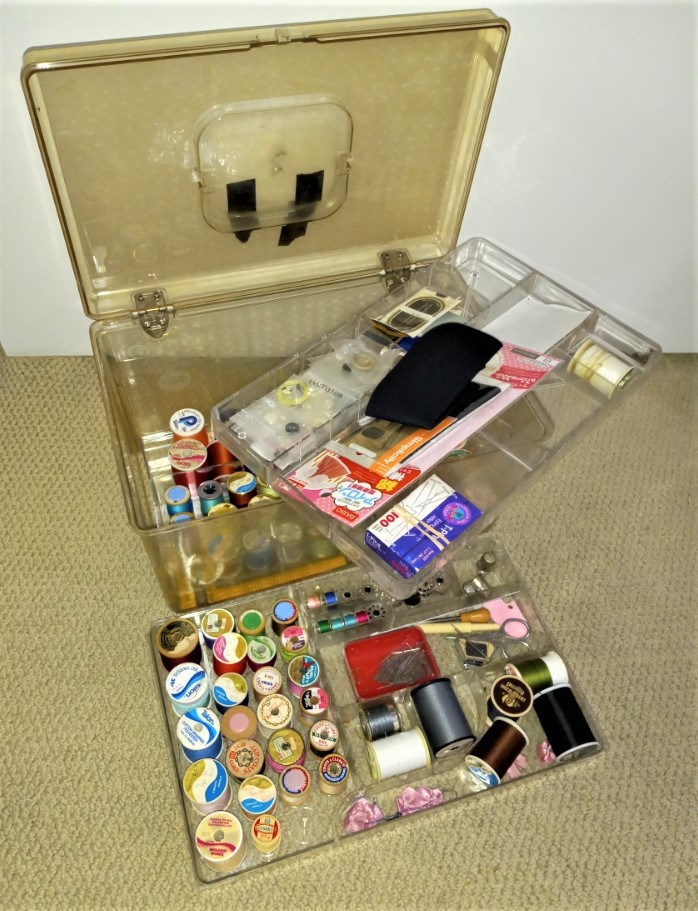
This story is about sewing, and the image above will become relevant as you read on.
Sewing by hand is becoming a lost art, and I'll be damned if I let it go without a fight. The dance with needle and thread has impacted me in many ways, and I'm grateful to the those who taught me how to replace a button... attach a patch... set a hem... repair a rip.
It's a quiet and singular activity that, much like ironing, can push a certain button in certain people. I like to iron too, but I'm weird that way.
Aunt Peggy
During Grade school, my younger brother and I lived with Aunt Peggy and Uncle Tony while Dad worked hard to create a new space for his two young sons. This is a common arrangement in many families, yet the benefits of that time so long ago are still with me.
To help ends meet, Peggy took in laundry and ironing work, and her small home was always filled with clothes. Regular walking trips to the laundromat were a part of my days from 2nd to 5th Grade, and the rules for using a laundromat were burned into my hard drive at an early age.
After school, I'd sit and watch her iron and learned how to do it (I'm still an Ironing God). She also taught me the basics of hand-sewing, and sometimes she'd let me sew missing buttons onto a dress shirt before it was starched, ironed and hung, ready for pick-up. I was a weird kid, too.
Father Sews Best
My Dad is a jack-of-all-trades, so it wasn't a surprise that he was also pretty good with a sewing machine. When I landed the role of 'The Peddler' in my Junior High School production of 'Oklahoma!' during the 7th Grade, he figured out how to use Grandma's ancient machine to fashion a sporty suit coat out of leftover material scraps. He fabricated the coat while I hovered around him, watching it come together. I told everyone "My DAD made this coat!!"
During my Boy Scout years, Dad was heavily involved with (among many other things) starting an Indian dance team for our local Order of the Arrow chapter. With me at his elbow, he fabricated the entire costume I wore for several years at performances all over Southern California. He also sewed-up and decorated the full-sized 'tipi' seen in the image above, which our team used at Camporees and pow-wows. My Dad RULES.
Camping Capitalism
The image above was taken at Holt Scout Ranch (a.k.a. Camp Cedar Canyon), located in the San Bernardino (CA) mountains. During the summer of 1970, I was a Summer Camp Junior Staffer there and lived at camp for over two months on my own.
Scout Troops would arrive at camp on Sundays for a week of outdoor activities, campcraft classes and fun, departing on the following Saturday. As a Junior Counselor, I conducted First Aid classes and helped the senior staffers to keep things humming. I washed a LOT of dishes in the Mess Hall.
My sewing skills came in handy. Workers in the Camp Store (pictured at left above) knew I could sew and would send visiting Scouts that needed emergency clothing repairs to find me.
My typical charge was $1 per repair, and Scouts would gladly pay me to fix their torn clothes, sew a newly-earned merit badge onto their sash, or attach an official Camp badge on their Red wool Scout jacket. I always had extra cash to spend at the camp store.
The really cool part was that camp staff lived in large individual tents on raised wooden platforms, with electricity! I had a portable record player, an incense burner and my 'Easy Rider' poster in there. Many evenings found me sewing by lantern light, blasting 'Inagaddadavida' into the surrounding forest.
Stitching One Together
I've been lucky to have spent quality time in fast cars on different kinds of race tracks. During my first session at the Jim Russell Racing Driver's School in Sonoma (CA), I unlearned as much as I learned about car control.
In the first classroom day, the instructor kept saying: "The goal is to stitch together a good lap, and then do it over and over again."
This relates perfectly to sewing, and the title of this story.
In motorsports, every turn is another opportunity to screw up the lap. When producing autocross-style tire testing events, I'd do a track walk with the participants, stopping at the entrance of each turn to recommend where the car should be placed, when to brake, when begin the turn and when to accelerate out of the turn. My favorite advice (Thanks, Mark Richter!) was, "Anyone can drive fast INTO a corner. The secret is being able to drive fast OUT of a corner."
Note: watch this vid on 'full-screen' It'll be worth it.
(Not me.)
Anyone who sews knows that every stitch is vital to the integrity of the finished product. A missed or incorrect stitch can weaken the whole, with failure as a likely result. In the autocross video above, each cone turn is another chance to mess up the lap, and the driver messes up a few of them. He's trying to 'stitch one together'... to take each turn just right to keep up his speed and momentum, thus achieving a quick elapsed time.
When I'm patching a pair of jeans, I make double-doggone-sure every stitch is where it needs to be so the repair doesn't fail and the patch stays where it's supposed to. In motorsports and sewing, the goal is to make every stitch count.
Heart-shaped Box
The sewing kit shown above is the reason I was inspired to write this essay. It belonged to The Artist's Grandmother Lila, and I loved her dearly. When she passed many years ago, we inherited both her sewing machine and this sewing kit, which I use all the time.
When I sit down and open the lid to repair a piece of clothing, Lila's with me. When I use a needle or thread or scissors or thimble or stitch ripper, it's like I'm communing with her across time and space. Holding those precious things in my hand gives me joy for having known and loved Lila so much, and I think about her all the time, even when I'm not sewing.
The vintage plastic case is now old and fragile, and my head was filled with slow-motion visions of the handle breaking and the kit crashing to the ground, exploding into a thousand pieces. I taped down the handle and cradle it in my arms when carrying it.
Sewing isn't for everyone. Neither is ironing. Both are becoming irrelevant, but I dinna care. I get satisfaction from doing both and will continue until I'm no longer able. Whatever happens to Lila's sewing kit when I depart this mortal coil is of no consequence because I won't know. I hope that another person who loves the intricacies of sewing will see the kit as I have: as a time machine... an homage to human skill and ingenuity... as a way to help their favorite jeans last just a little bit longer.
(again, full screen).
(Definitely not me.)
Images of Peddler coat, Indian costume, summer camp and sewing box by the Author, all other images Thanks to GoogleImages; All videos Thanks to YouTube.
This true story is dedicated to my friend, Rhae Lynn.
It started with a conversation about the album cover pictured above for Leon Russell's 'Carney', released in 1972. I'm pretty sure I still have this vinyl in my collection.
Our conversation took place at a company I worked at for over 12 years. The business specialized in automotive film production services and our facility included a full-sized photo studio that hosted shoots for both still photography and videos. The shoots were mainly centered around the vehicles from our primary client, a Korean auto manufacturer.
That's where I met Rhae Lynn, who was crewing as a make-up artist for a photo shoot. She stood 5 feet tall, was several years older than me, and we became Green Room friends right away. She was one of the regulars in a production crew that used our studio throughout the year, and we remained friends after I left the company.
Sadly, she passed away after a sudden illness in early 2022, but not before we'd begun talks for me to write an autobiography about her lifelong career as a make-up artist. She'd already chosen the title of her book, but since it never happened I use it here in her honor (more about that title later).
Our rambling talks about her career piqued my interest in the famous make-up artists that inspired her to take up the profession.
Max Factor. Ben Nye. George Westmore (and his sons Monte, Perc, Ern, Wally, Bud and Frank). Jack Dawn. William Tuttle. Jack Pierce. If you've seen any of the classic Hollywood films, you've seen their work, from 'Frankenstein' to 'Planet of the Apes', from 'The Wizard of Oz' to '2001: A Space Odyssey'.
These names (and many more) were the Hollywood legends that gave Rhae Lynn the passion to become a make-up artist. Over the past several years, my wife and I have become big fans of the 'film noir' genre that took place in the 40s and 50s, so now I read the film credits like a treasure map, searching for those names. They matter to me now, too.
Max Factor
According to de Wiki, since make-up was already used in the theater, the early film industry used those same techniques but found them to be sorely lacking. The combination of the crude celluloid film stock used and how the theatrical make-up colors translated onto film wound up looking like grotesque masks. It was Max Factor who developed the more subtle colors and application methods to tone down the looks. Along with his invention of Pancake make-up, his gentle application methods and the higher-quality film stocks being used, his products and methods became the benchmark for everything else that followed in the make-up industry.
George Westmore
It really took off when film stars began to appear off-screen in the same make-up they wore in front of the cameras. When that happened, Pancake make-up became essential for any woman who was conscious of her appearance.
Jack Pierce
When she decided as a teenager to become a make-up artist, Rhae Lynn's family was horrified. They were sure she'd never be able to make a living that way and tried to change her mind, but no dice. She was short and fiery and had made her decision, so a long and successful career was the result of her choice.
In one of our conversations, she admitted it wasn't an easy career choice. At first she felt like a nomad, following production crews around while trying to pierce their insular world, trying to convince someone... ANYONE... that she had the skills. Once she broke through, the job she'd dreamed of became a decades-long grind of location shoots, endless studio days and equally endless periods of waiting by the phone for the next job, the next chance to earn some money and keep going.
But she loved her chosen profession.
She especially loved the people she came into contact with: production crew members, location managers and techs, and especially the talent and clients. She told me about working on a young actress in a shlock horror film who would be almost nude while on-camera. After an arduous make-up session, the actress inspected herself in the mirror and asked "Can you make my nipples pinker?" Thus, Rhae Lynn's autobiography title was born, along with the title of this homage.
The story that resonates most was about the photo shoot for the 'Carney' LP cover.
She was still in her early twenties and just getting her foot into the studio door. She was tapped to do make-up for a photo shoot where the primary tech had to bow out at the last minute. Although still a newbie and not sure what to expect, she gladly took the job.
She arrived on-set and was directed to a small trailer. She stepped inside and came face-to-face with Leon Russell (whom she'd never heard of), a Southern blues rocker and hard-partier. He was slouched in the make-up chair, holding an open can of beer, drunk. She introduced herself and he belched in reply. "Oh Lord", she thought to herself, "What have I gotten myself into?"
She reviewed the production notes for the make-up application and started, but Leon was abusive and obnoxious, burping in her face as she worked and spitting beer at her. She was ready to drop her brushes and run out, but kept calm and kept working on him.
When she was almost done, he shouted "FUCK THIS!!!", jumped out of the chair and stormed into the trailer's tiny bathroom, slamming the door so hard it shook the trailer. She was mortified and began to pack up her gear, certain that she'd be fired for pissing off the talent. She was ready to leave when the bathroom door opened. Leon came out with a big smile and said "Hey... you did a GREAT job, I look FANTASTIC!!" He thanked her and went outside, leaving her dumbfounded.
She told me that's when she knew she could be a real make-up artist.
Leon and the trailer.
I regret not being able to write her autobiography. I can't remember the countless names she dropped of celebrities she'd worked on, their eccentricities and her interaction with them. I missed out on the chance to write her story, but her smiling face and raucous laugh are always with me.
Thanks, Rhae Lynn... for being my friend and cohort, for opening my eyes to your profession, and for being an awesome human being. I'll never forget you.
R.I.P. Rhae Lynn Stitt (19?? - 2022)
RLS imagen, gracias de Facebook, todos las demas fotos, gracias de Google Images; todos las videos, Muchisimas Gracias de YouTube. "We're lost in a masquerade."
1969 was a year of massive change that reflected and resonated all across the country. From Woodstock to the Moon landing, anyone above the age of 8 knew things were different and would only continue to be new, weird and exciting.
The Summer of '69 saw me as a 12-year-old heading into the 8th Grade, obsessed with drag racing, MAD Magazine, rock music and GIRLS. I'd been a Boy Scout for almost 2 years and our Troop was one of only a few that regularly held dance parties with local Girl Scout Troops, some hosted at my house since Dad was our Scoutmaster.
It was COOL.
I had my very first job that summer, a referral from the Willow Junior High recreation department. It involved volunteering at a local library in a shopping center near the school, helping with book returns and reading to kids and general cleanup. It was only a few hours a day, a few days each week for a couple of months, and Dad thought it would be a good way to keep me occupied during those long hot no-school days.
Volunteering at the library was fun, especially since I'd recently discovered the world of science fiction and was inhaling books by Asimov, Heinlein and Bradbury. I had to wear dress clothes and shoes (remember those?) so I felt like I belonged in that clean and quiet space... pushing around a cart filled with books to be shelved and helping visitors navigate the dreaded Dewey Decimal System.
One day a girl came in looking for a book and I was stopped in my 12-year-old tracks. She was my age, pale and pretty with long straight blonde hair and dark eye shadow, wearing a plaid mini-skirt and white go-go boots, looking like a teenage Twiggy. She asked for help finding a book, and after missing a beat while I stood there slack-jawed, we hit the card catalog and I found the book for her in the shelves. With a big smile and fluttering eyelashes, she thanked me and went to Check-out.
I wasn't the same for the rest of the day.
I didn't get her name. I knew nothing about her.
And against all odds, the next time I worked at the library, she came in again.
Now, I didn't know if it was a coincidence but this time I made sure to talk to her as much as I could. She told me her friends called her Spooky (?!?), she went to a rival junior high near the library, lived just a few blocks away and read a lot of books but no sci-fi. Before I knew it, she was gone... POOF!
We wound up seeing each other over the next few weeks. Sometimes after I was done at the library we'd walk to the Thrifty Drug lunch counter in the shopping center to grab a fresh-dipped ice cream cone and just talk. We blabbed about school and friends and books and laughed a lot, all very junior-high but I was crushing on her. It felt like she could be my first real possibly maybe girlfriend and we were 'going around'! She wouldn't let me walk her home, so we'd stroll to the edge of the shopping center, rolling my 10-speed bike between us, before she'd split across the street when the light turned Green and... POOF, gone again.
Then it happened. Once after the ice cream and the goofy talk and the stroll to the intersection... before she left, she kissed me. I mean, a real honkin' French Kiss with tongue and everything! Hoo boy, it felt great as we kissed right there on the corner for the whole world to see. WOW.
The next time we met, she asked me to stop by her house later that evening to hang out. I clearly remember getting ready in my room, lying to my Dad that I'd be racing slot cars with a Scouting friend nearby and then riding my bike to her house, SO NERVOUS. Would her folks tell me to leave their daughter alone? Would she invite me inside to watch TV and make out? What if she wasn't home? I didn't even know her real name!
The streetlights had just come on when I arrived in front of her house, a slightly rundown place with a dirt front yard and a ratty covered porch. I could see the lights were already on inside through the front window, covered with torn drapes.
I rang the doorbell and after a looooong minute, she opened the front door and came out onto the porch, quickly closing the door behind her. Naturally I thought she'd hug or kiss me but instead we both just sat down on the porch bench. We were there for a few minutes, not saying anything, and then she told me she couldn't hang out and that maybe I shouldn't have come over. Then I heard someone inside the house shout:
"HEY... SPOOKY!!! WHATCHOO DOING OUT THERE?? GET BACK IN HERE!!!"
Me: "Soooo... who's that inside calling you? Is it your Dad or your Brother?"
Her: "No, it's my boyfriend. I wasn't expecting him tonight and I didn't have your phone number so I couldn't call to tell you not to come over."
Me: "Your... boyfriend? He sounds a lot older than us."
Her: " He is... he's a Senior in high school."
Me: "WHOA... he's a LOT older than us. Does he know I'm here?"
Her: "Yeah, but I told him you were a just a friend dropping off a school book. He's pretty jealous, so you'd better take off before he comes out here and gets mad and beats you up."
And that was it. Without another word, she went inside the house and I jumped on my bike and pedaled away, feeling hurt and betrayed. I rode around in the dark neighborhoods and after a while went home to my room, turned on the radio real loud and cried like a big stupid baby.
She didn't come into the library again, and even though I knew where she lived, I never rode by her house and then my Summer library job was over. It all happened in the span of about a month, so after a while it seemed like it never happened at all.
And then it was time for 8th Grade... the cute girls, Friday afternoon sock-hops, Saturday night dances and all the stuff we took for granted. For the longest time I tried not to think about Spooky again because it hurt, but even that eventually faded away and I knew it wasn't supposed to be. She knew it too.
I'll never EVER forget that kiss with Spooky on the corner of Amar and Orange Avenues in La Puente, California in the Summer of 1969, near the Food Giant and the library, only a few miles from home but a million miles from everywhere.
Epilogue: all the tunes above were on the radio in the Summer of 1969, and now they sound simple and beautiful and meaningful. In fact, I recently heard all these songs on a Spotify feed in one afternoon, which inspired me to write about Spooky. For me, everything began to change in 1969, and I mean EVERYTHING.
I know this much: I'll always be grateful to have been 12 years old in 1969.
Lead Image, gracias de Google Images; all videos, muchisimas gracias de YouTube.


.jpg)

.JPG)
.JPG)